Does home insurance cover your boat in South Carolina?
If you own a boat and a home in South Carolina, the question is reasonable: does home insurance cover my boat, or do I need a separate policy? The short answer is that your homeowners policy offers some coverage, but far less than most boat owners expect. Knowing exactly where that coverage stops, and what happens when you are out on the water in a state where boating accidents and hurricane damage are real possibilities, can save you from a very expensive surprise.
What homeowners insurance actually covers for boats
A standard homeowners policy in South Carolina (typically an HO-3 form) extends personal property coverage to your boat, but only under narrow conditions. Most policies include the following by default:
- Theft from your property. If your boat is stolen from your driveway or stored on your lot, your personal property coverage may reimburse you up to your policy's sub-limit for watercraft.
- Limited liability. Some HO-3 policies include a small watercraft liability provision, often capped at $1,000 to $2,500 in coverage for the boat itself.
- Fire and certain named perils. If your boat is destroyed in a fire while stored on your property, it may be covered under the personal property section.
Notice what is missing: coverage while the boat is on the water, coverage for physical damage from a storm or collision, and any meaningful liability protection if someone is injured on your vessel. Those gaps are not minor. On the Grand Strand coast, where watercraft losses during hurricane season can be severe, relying on a homeowners policy alone is a real risk.
Where homeowners coverage falls short
South Carolina homeowners are especially exposed because of the state's geography. The Intracoastal Waterway runs the length of the coast, and boating is an everyday activity for residents from Myrtle Beach down to Pawleys Island and up to Little River. That means more time on the water, and more opportunity for losses a homeowners policy simply does not cover.
Sub-limits are very low
Most standard homeowners policies cap watercraft coverage at $1,500 . If your boat is worth $25,000 or $50,000, that number is essentially meaningless. You would be covering the remaining loss out of pocket.
No on-water physical damage
Once your boat leaves the dock, your homeowners policy stops protecting it. If you hit a submerged object in Murrell's Inlet, run aground near Garden City, or suffer storm damage while anchored in the Waccamaw River, you have no physical damage coverage under a homeowners policy.
Little to no liability protection
Boating liability is a serious exposure. If you are involved in a collision and someone is injured, medical bills and legal costs can reach hundreds of thousands of dollars. South Carolina does not require a boating license for most recreational boaters, but it does require compliance with state and federal navigation rules. A judgment against you for a boating accident could be financially devastating without standalone watercraft liability coverage.
Hurricane and named storm damage
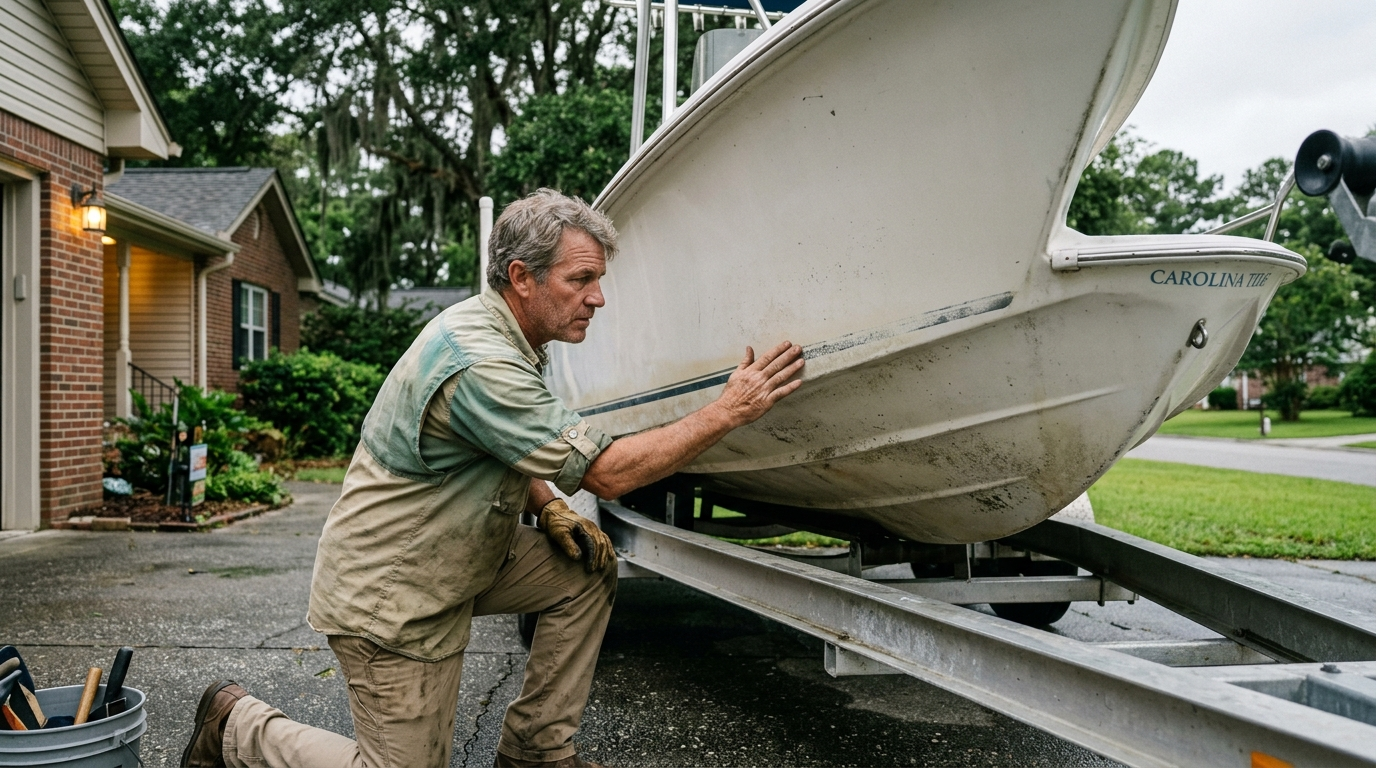
South Carolina homeowners already deal with hurricane deductibles on their home policies. Boats stored in the water or on a trailer in the yard during a named storm are often specifically excluded from personal property claims under many HO-3 policies. This is a serious gap during Atlantic hurricane season, which runs June through November and regularly affects the Grand Strand.
What a standalone boat insurance policy covers
A dedicated boat insurance policy in South Carolina fills all of those gaps. Coverage is built specifically around how boats are actually used and how losses actually happen. A typical policy includes:
- Physical damage (hull coverage). Covers collision, sinking, fire, theft, and storm damage whether the boat is on the water, in storage, or on a trailer.
- Bodily injury liability. Covers medical expenses and legal defense costs if someone is injured in an accident involving your vessel. Limits typically start at $100,000 and can go much higher.
- Property damage liability. Pays for damage you cause to another vessel, dock, or structure.
- Uninsured/underinsured boater coverage. Protects you if the other party in an accident has no insurance. South Carolina does not require boat insurance by law, so uninsured boaters are common.
- Medical payments. Covers medical costs for you and your passengers regardless of fault.
- On-water towing and assistance. If you break down or run out of fuel on the water, towing coverage gets you back to the dock without a major out-of-pocket bill.
- Personal effects. Covers fishing gear, electronics, and other equipment on board.
For larger or higher-value vessels, some carriers also offer agreed value coverage, which pays the full insured value with no depreciation deduction in the event of a total loss. If you are considering that option, our post on agreed value boat insurance in South Carolina explains when it makes sense and how it compares to actual cash value policies.
How much does boat insurance cost in South Carolina?
Rates vary depending on the type and size of your boat, how and where you use it, your boating experience, and the coverage limits you choose. As a general reference for South Carolina boat owners:
- Small motorboats and Jon boats. Often $150 to $400 per year for a basic policy.
- Pontoon boats. Typically $300 to $700 per year depending on length and value.
- Bowriders and ski boats. Often $400 to $900 per year for a well-equipped vessel.
- Larger offshore or center console boats. Can run $1,000 to $3,000 or more per year based on hull value and navigation territory.
These are rough benchmarks, not quotes. An independent agent can compare actual rates from multiple carriers based on your specific boat and situation. For a closer look at what goes into the pricing, see our guide to boat insurance costs and coverage in South Carolina.
South Carolina boating laws you should know
South Carolina does not mandate boat insurance the way it mandates auto insurance, but the state has rules that create real liability exposure for boat owners. A few worth knowing:
- Boater education. Anyone born on or after January 1, 1998 must complete a state-approved boater education course to operate a motorized vessel. Violations can result in fines and may affect an insurance claim if an accident occurs while an uncertified operator is at the helm.
- BUI laws. South Carolina's Boating Under the Influence statute (S.C. Code 50-21-112) carries penalties similar to a DUI. A BUI conviction also creates serious problems with any insurance claim and can result in policy cancellation.
- Registration requirements. All motorized watercraft operated on South Carolina waters must be registered with the South Carolina Department of Natural Resources (SCDNR). Failure to register can complicate a claim.
- Personal watercraft rules. Jet skis and other personal watercraft have additional operating restrictions in South Carolina, including age minimums and required safety equipment. If you own a PWC, a personal watercraft policy is worth considering separately from a boat policy.
When your homeowners policy might be enough (and when it is not)
There are a small number of situations where relying on your homeowners policy for a boat is not completely unreasonable. If you own a very small rowboat or canoe with a value under $1,500, your personal property coverage might cover a theft and the liability exposure is minimal. That is about where reasonable reliance on a homeowners policy ends.
For anyone with a motorized vessel, a sailboat, a pontoon, or anything used on open coastal waters near Myrtle Beach, North Myrtle Beach, Surfside Beach, or the surrounding waterways, a standalone policy is the right move. The on-water liability exposure alone is worth the premium several times over. A single boating accident with injuries can produce a claim that exceeds a homeowners umbrella policy's limits if you do not have underlying watercraft liability in place.
On the subject of umbrellas: if you have a personal umbrella policy, check whether your insurer requires underlying watercraft liability coverage before the umbrella applies to a boat-related claim. Many do, and if that underlying coverage is missing, your umbrella may not respond to a boating accident at all.
Get the right boat coverage with L. W. Short Insurance Agency
L. W. Short Insurance Agency is an independent insurance agency serving the Grand Strand and surrounding areas, including Myrtle Beach, Conway, Pawleys Island, Garden City, Little River, and communities across Horry and Georgetown counties. As an independent agency, we are not tied to a single carrier. We compare rates and coverage options from multiple insurers to find the policy that fits your boat, your budget, and the waters you actually navigate.
If you have been wondering whether your current home policy truly covers you out on the water, the honest answer is probably not. Give us a call at (843) 357-7493 or reach out through our contact page to talk through your situation. We will review what you have now, identify any gaps, and help you get a boat insurance quote that gives you real protection before you head out this season.